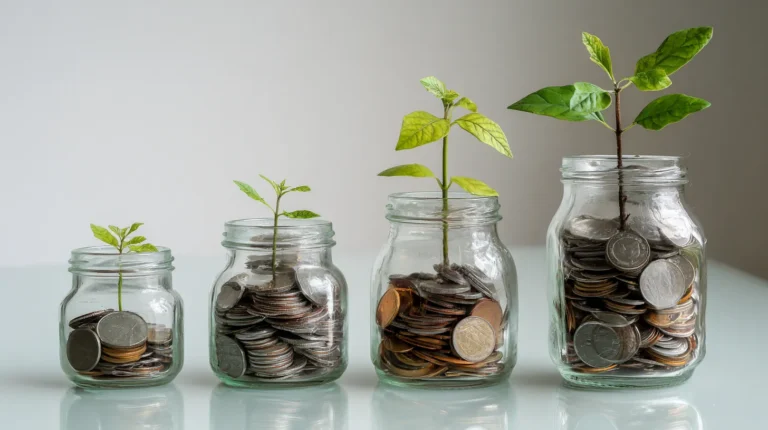
If you’re searching how to build wealth from scratch in your 20s, you’re already ahead of most people.
Many wait until their 30s or 40s to think seriously about money. However, your 20s offer one powerful advantage: time. Because wealth grows exponentially through compounding, starting early multiplies results dramatically.
You do not need a high salary.
You do not need family money.
You do not need perfect financial knowledge.
Instead, you need strategy, discipline, and long-term thinking.
Let’s break down exactly how to start.

Why Your 20s Matter More Than You Think
Time works as your greatest financial asset.
When you invest early, compound growth accelerates your results. Therefore, even small monthly contributions can turn into significant wealth over decades.
Consider this comparison:
| Monthly Investment | Start Age | Age 60 Value (7% avg return) |
|---|---|---|
| $300 | 22 | ~$745,000 |
| $300 | 32 | ~$355,000 |
| $300 | 42 | ~$155,000 |
The difference does not come from higher contributions. It comes from time.
Because of compounding, every year you delay reduces long-term growth.
Step 1: Master Your Cash Flow
Before investing, control your income and expenses.
Wealth building starts with surplus. Therefore, track your monthly spending carefully.
Focus on:
- Fixed expenses (rent, utilities, insurance)
- Variable spending (food, entertainment, shopping)
- Debt payments
Once you understand your numbers, you can optimize them.
Even increasing your savings rate by 5–10% dramatically improves long-term results.
Step 2: Build an Emergency Fund First
Before investing aggressively, build financial stability.
Aim for at least 3 months of essential expenses. If your income fluctuates, consider 6 months.
This fund protects you from:
- Job loss
- Medical expenses
- Unexpected repairs
Without it, you may liquidate investments during emergencies. Therefore, stability supports growth.
Step 3: Eliminate High-Interest Debt
High-interest debt destroys wealth accumulation.
Credit card interest often exceeds 20%. Meanwhile, most investments average 7–10% long-term.
Therefore, paying off high-interest debt produces guaranteed returns equal to the interest rate.
Once you eliminate expensive debt, redirect those payments into investments.
Step 4: Start Investing Early
Investing creates wealth. Saving alone preserves money.
In your 20s, consider long-term growth assets such as:
- Broad-market index funds
- Retirement accounts (401(k), IRA)
- Tax-advantaged investment accounts
Even small contributions matter.
For example:
| Monthly Investment | 10-Year Value (7%) |
|---|---|
| $200 | ~$34,000 |
| $400 | ~$69,000 |
| $600 | ~$103,000 |
While early numbers may seem small, growth accelerates over time.
Consistency matters more than perfection.
Step 5: Increase Your Income Strategically
While budgeting helps, income expansion accelerates wealth.
In your 20s, focus on:
- Skill development
- Certifications
- Negotiating salary increases
- Side income opportunities
Because income potential grows over time, investing in yourself produces the highest return.
Additionally, avoid lifestyle inflation. When income increases, increase investments — not just spending.
Step 6: Automate Everything
Automation removes emotion.
Set automatic transfers for:
- Savings
- Retirement accounts
- Investment contributions
By paying yourself first, you eliminate the temptation to overspend.
Discipline becomes automatic.
Step 7: Understand Compound Growth
Compound growth means you earn returns on both your original investment and previous returns.
Here’s a simplified example:
| Year | Starting Balance | 7% Growth | Ending Balance |
|---|---|---|---|
| 1 | $10,000 | $700 | $10,700 |
| 2 | $10,700 | $749 | $11,449 |
| 3 | $11,449 | $801 | $12,250 |
Growth accelerates over time.
Therefore, patience becomes profitable.
Step 8: Avoid Common Wealth Killers
Many people sabotage their financial future early.
Avoid:
- High-interest debt cycles
- Constant lifestyle upgrades
- Emotional investing
- Ignoring retirement accounts
Additionally, avoid comparing yourself to others. Social media often exaggerates success.
Instead, focus on steady progress.
Step 9: Think Long-Term, Not Fast Money
In your 20s, you may feel tempted by “get rich quick” strategies.
However, sustainable wealth grows steadily.
If you invest consistently for 30–40 years, even moderate returns create financial independence.
Long-term discipline outperforms short-term speculation.
Step 10: Build Multiple Income Streams Over Time
Eventually, wealth grows faster when income diversifies.
Examples include:
- Rental income
- Dividend investments
- Business ownership
- Freelance or consulting work
However, build foundations first. Focus on savings and investing before expanding aggressively.
Strong fundamentals reduce risk.
How Much Should You Invest in Your 20s?
Aim for at least 15–20% of your income if possible.
If that feels overwhelming, start with 5–10% and increase annually.
The key principle:
Increase your investment rate every time your income grows.
Small upgrades compound massively over decades.
Final Thoughts: Wealth Is Built Through Habits
If you’re asking how to build wealth from scratch in your 20s, understand this:
Wealth does not require luck.
It requires time, discipline, and strategic action.
Control your spending.
Eliminate high-interest debt.
Invest early and consistently.
Increase income gradually.
Your 20s offer something priceless: time leverage.
And in wealth building, time beats everything else.
Start now — even small steps count.
Because the sooner you begin, the easier financial freedom becomes.